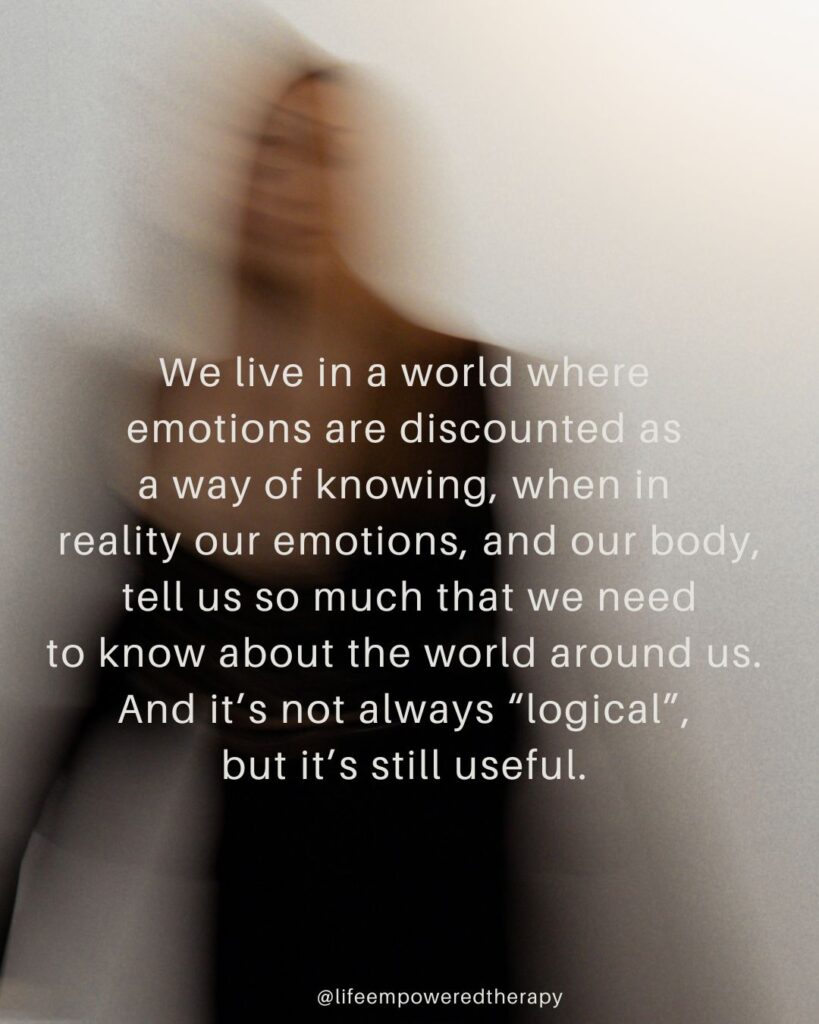
Intuition in feelings and the body
The Wisdom of Emotions: How Our Bodies Tell the Story Logic Can’t
Emotions are more than fleeting feelings—they’re messages, data points, and stories that live in the body. For many of us, especially those who have experienced trauma, our emotional world can feel overwhelming, confusing, or even threatening. But what if, instead of avoiding or overriding our emotions with logic, we listened more closely to what they were trying to say?
Emotions as Living History
Our emotions carry the imprint of everything we’ve lived through. They don’t just arise in the moment; they echo from the past. When trauma occurs, the body and nervous system may remain locked in a loop, constantly reliving or reacting to that painful experience. While this can feel distressing or disorienting, it’s also a form of inner communication. Our system is trying to say: “This mattered. This changed me. I still need help understanding or healing this.”
Rather than seeing trauma responses as irrational or broken, we can start to see them as signals—unfinished stories, waiting to be acknowledged and integrated. That emotional pain or chronic tension isn’t just “in our head”—it’s in our body, and it’s real.
The Body’s Language is Subtle—but Powerful
Emotions don’t always come with a neat narrative. Sometimes we feel fear, resistance, or a strong pull toward or away from something without knowing why. That’s because the body and brain are synthesizing an enormous amount of information—much of it subconscious. What we call a “gut feeling” or “intuition” is the result of complex pattern recognition, a quiet wisdom that logic doesn’t always catch up with.
This is why we might sense that something is wrong (or right) long before we can explain it. When we ignore these signals in favor of pure rationality, we may end up in situations that make sense on paper but feel entirely wrong in our hearts.
Responding with Compassion, Not Just Logic
Understanding our emotions—truly being with them—allows us to respond to ourselves in a way that logic alone never can. While reason helps us make sense of the world, emotions help us experience it fully. Together, they create a more holistic understanding of who we are and what we need.
When we pause to notice what our emotions are telling us—whether it’s discomfort in a conversation, a sudden wave of sadness, or joy that catches us off guard—we get clues about our values, boundaries, desires, and fears. This information can guide us toward better choices, deeper healing, and a more aligned life.
An Invitation
What I’ve seen again and again is this: the people who learn to listen to their bodies and emotions—not suppress them—are often the ones who find the most meaningful and sustainable healing.
So I invite you to ask yourself:
- What is my body trying to tell me today?
- Is there an emotion I’ve been avoiding that might hold a message I need to hear?
- Can I respond to myself with the same care I would offer a friend?